
机器学习与AIMachine-Learning Potentials and Large-Scale Simulation

Current Service Inquiry

Universal Potential Assessment and Fine-Tuning

universal MLIP, MACE-MP, CHGNet, DPA, zero-shot evaluation, fine-tuning, force error, property validation
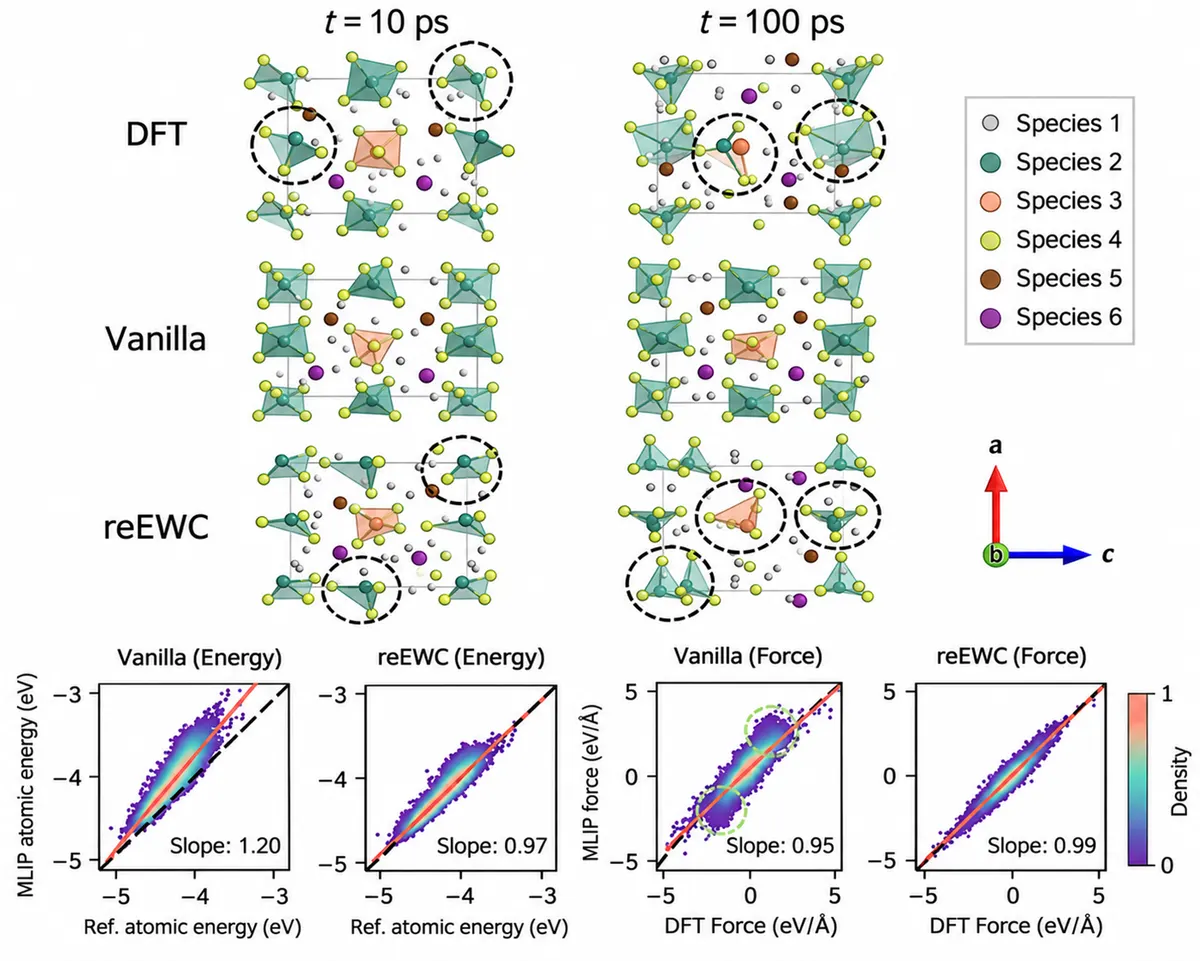
Results Display
Image is for technical case explanation only and does not represent company project results or a specific client case.

Calculation Purpose

Evaluate a universal machine-learning potential on the target material and, when needed, fine-tune it with a small first-principles set to improve energies, forces, and key properties.

Case Reference

An efficient forgetting-aware fine-tuning framework for pretrained universal machine-learning interatomic potentials

Pretrained universal machine-learning interatomic potentials (MLIPs) have revolutionized computational materials science by enabling rapid atomistic simulations as efficient alternatives to ab initio methods. Fine-tuning pretrained MLIPs offers a practical approach to improving accuracy for materials and properties where predictive performance is insufficient. However, this approach often induces catastrophic forgetting, undermining the generalizability that is a key advantage of pretrained MLIPs. Herein, we propose reEWC, an advanced fine-tuning strategy that integrates Experience Replay and Elastic Weight Consolidation (EWC) to effectively balance forgetting prevention with fine-tuning efficiency. Using Li₆PS₅Cl (LPSC), a sulfide-based Li solid-state electrolyte, as a fine-tuning target, we show that reEWC significantly improves the accuracy of a pretrained MLIP, resolving well-known issues of potential energy surface softening and overestimated Li diffusivities. Moreover, reEWC preserves the generalizability of the pretrained MLIP and enables knowledge transfer to chemically distinct systems, including other sulfide, oxide, nitride, and halide electrolytes. Compared to Experience Replay and EWC used individually, reEWC delivers clear synergistic benefits, mitigating their respective limitations while maintaining computational efficiency. These results establish reEWC as a robust and effective solution for continual learning in MLIPs, enabling universal models that can advance materials research through large-scale, high-throughput simulations across diverse chemistries.

Read Article

Scan the QR code with WeChat for free consultation

If you are not sure which plan fits, send us your requirements.

Email: chengyankeji2026@163.com

Contact Us

WeChat QR Code

WeChat QR Code

Not sure which calculation fits? Share your material system and goal, and we will help assess the plan first.

Order now