
材料加工与表面工艺Laser Processing and Additive Manufacturing

Current Service Inquiry

Thermal Distortion in Laser Welding and Additive Manufacturing

noitarbilac ecruos-taeh ,seigetarts gninnacs ,noitrotsid ,sserts laudiser ,selcyc lamreht ,sdleifTemperature 
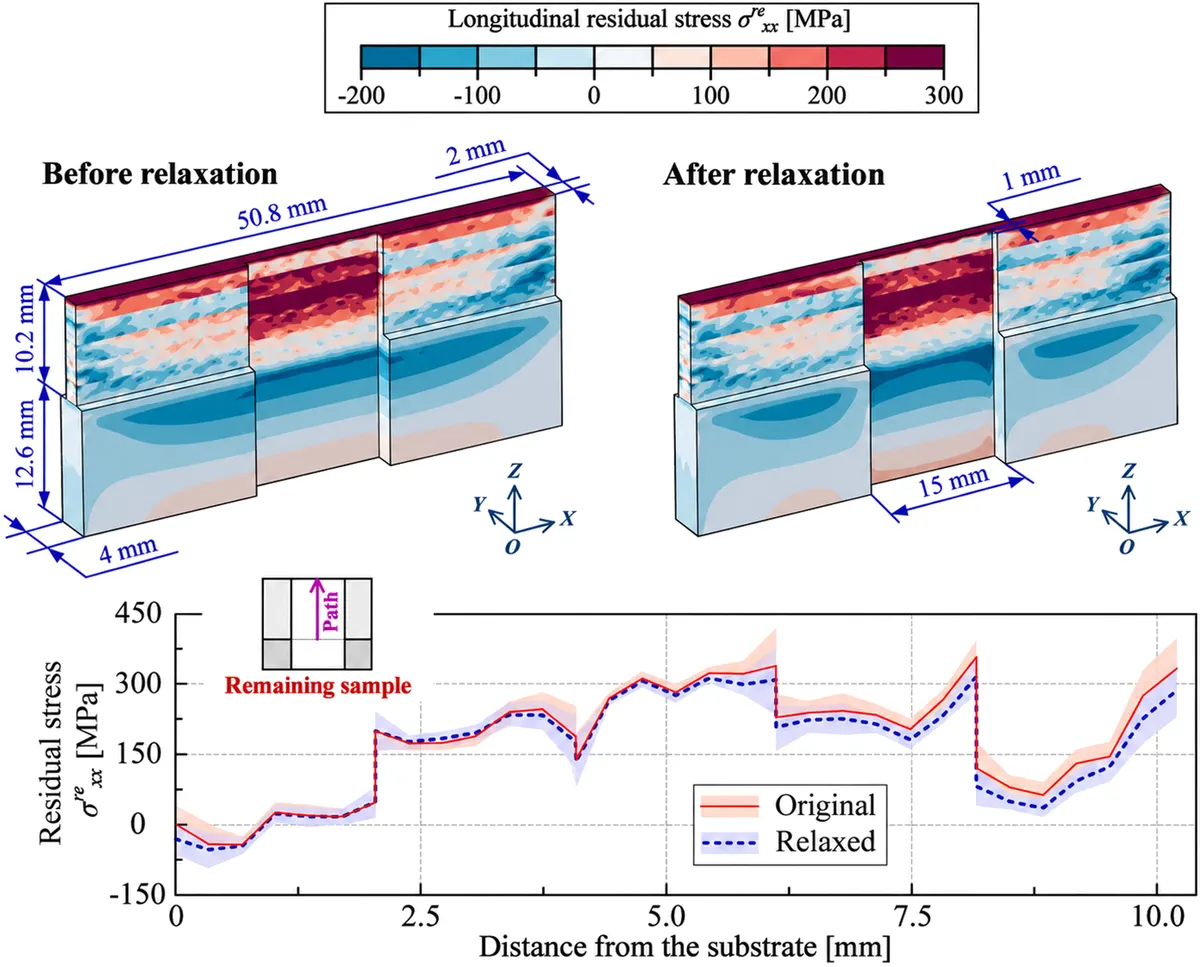
Results Dis
Image is for technical case explanation only and does not represent company project results or a specific client case.

Calculation Purpose

.secruos taeh detarbilac gnisu selcyc lamreht gnirutcafunam-evitidda dna gnidlew yb decudni noitrotsid tnenopmoc dna sserts laudiserCompare 

Case Reference

Understanding residual stress in functionally graded directed energy deposition

Residual stress within functionally graded material (FGM) fabricated by directed energy deposition (DED) limits their industrial application. This paper presents a new model for predicting residual stress in the DED-built FGM thin-wall structures, accommodating any DED process configurations or material combinations. To validate this model, SS316/IN718 FGM thin-wall structures were produced by powder-fed laser DED processes, and residual stresses along the laser traverse direction were measured by X-ray diffraction techniques. Under the same deposition parameters, five material composition transition paths from SS316 to IN718 were employed to quantify the effect of material mixing properties on the residual stress distribution. One path was based on the designed weight percentages of SS316 and IN718 in each deposition layer, while the other four paths were determined by detecting the average weight ratios of four elements: iron (Fe), nickel (Ni), niobium (Nb) and titanium (Ti). The predicted residual stress profiles agreed with the measurements, with the maximum normalized root mean squared error (NRMSE) of 26.42% observed in Nb-based predictions. The validated model was further extended to investigate residual stress distribution in two types of FGM thin-wall structures featured by tilted material transition regions: vertical- and horizontal-dominant walls. Results suggest that maximum tensile residual stresses are proportionally related to the material gradient angle θ1 in vertical-dominant walls, while increasing the material gradient angle θ2 in horizontal-dominant walls results in more compressive residual stresses at the FGM’s top surface. Based on a comprehensive understanding of the process mechanism using this practical model, it is now possible to propose novel deposition strategies that allow the material specification to be met while offering a reduced residual stress solution.

Read Article

Scan the QR code with WeChat for free consultation

If you are not sure which plan fits, send us your requirements.

Email: chengyankeji2026@163.com

Contact Us

WeChat QR Code

WeChat QR Code

Not sure which calculation fits? Share your material system and goal, and we will help assess the plan first.

Order now