
电池Finite Element and Phase-Field

Current Service Inquiry

Cathode Particle Chemo-Mechanical Stress and Cracking

noitartnecnoc sserts ,noitazinegomoh noitartnecnoc ,erutcarf dleif-esahp ,stnemele etinif ,gnilpuocchemo-mechanical 
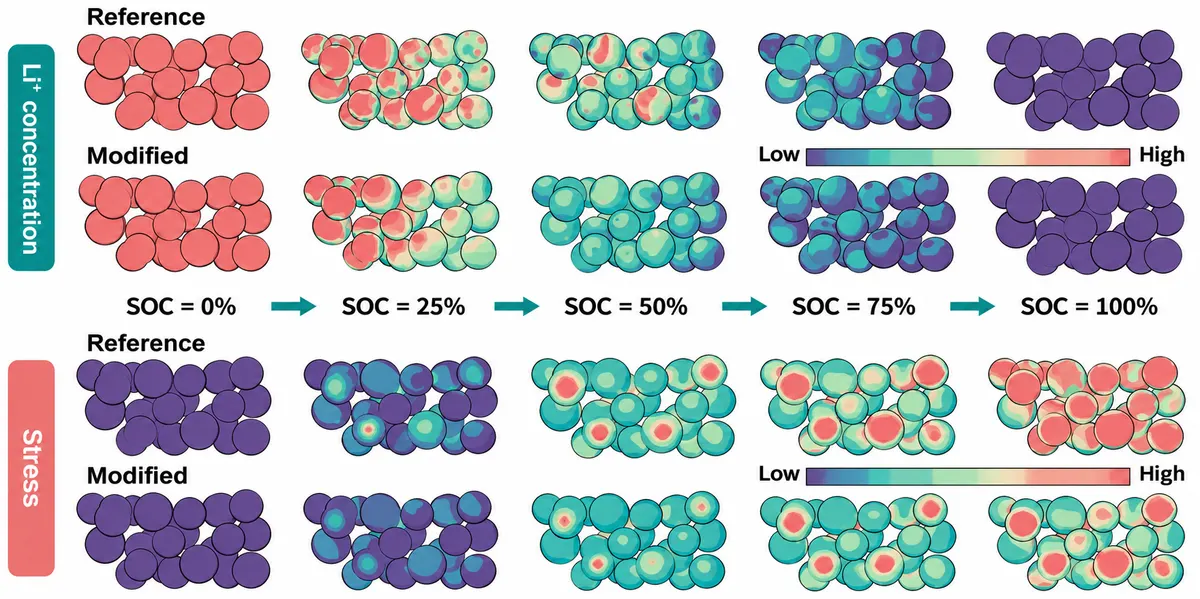
Results Display
Image is for technical case explanation only and does not represent company project results or a specific client case.

Calculation Purpose

 damage evolution during cathode particle (de)lithiation, and evaluate how surface/interfacial engineering homogenizes concentration, relieves stress and improves structural stability.dna sdleif sserts ,noitartnecnoc muihtilCompare 

Case Reference

Dual-Phase Composite Reinforcement Engineering Enhances the Cycle Stability of Li-Rich Mn-Based Cathode

Lithium-rich manganese layered oxides (LRMOs) are regarded as promising cathode materials for next-generation Li-ion batteries due to their high capacity. However, LRMOs are prone to irreversible oxygen desorption and localized stress concentrations during cycling, leading to structural collapse and capacity decay, limiting their practical application. Herein, this study innovatively proposes a dual-phase composite reinforcement engineering that achieves a homogeneous distribution of Li+ from the bulk to the surface, significantly enhancing the structural stability and electrochemical performance of the LRMO cathode. By in situ constructing dual-phase composite nanostructures on the surface of LRMO, specifically comprising an Fe-enhanced spinel outer surface and an Fe-gradient-doped layered structure in the subsurface. This strategy significantly reduces the Li+ diffusion barrier while effectively improving the uniformity of Li+ concentration distribution and the stability of the surface structure. Furthermore, Fe in the lattice forms highly stable Fe─O bonds, which increase the formation energy of oxygen vacancies and reduce the excessive oxidation of lattice oxygen. The modified LRMO exhibits an impressive capacity of 249.76 mAh⋅g−1 at 1C and maintains an outstanding capacity retention rate of 91.5% after 200 cycles. This innovative engineering tackles surface degradation for LRMOs, paving the way toward high-capacity and stable cathode materials.

Read Article

Scan the QR code with WeChat for free consultation

If you are not sure which plan fits, send us your requirements.

Email: chengyankeji2026@163.com

Contact Us

WeChat QR Code

WeChat QR Code

Not sure which calculation fits? Share your material system and goal, and we will help assess the plan first.

Order now