
Current Service Inquiry
Li–S Li₂S Deposition Morphology and Rate Distribution
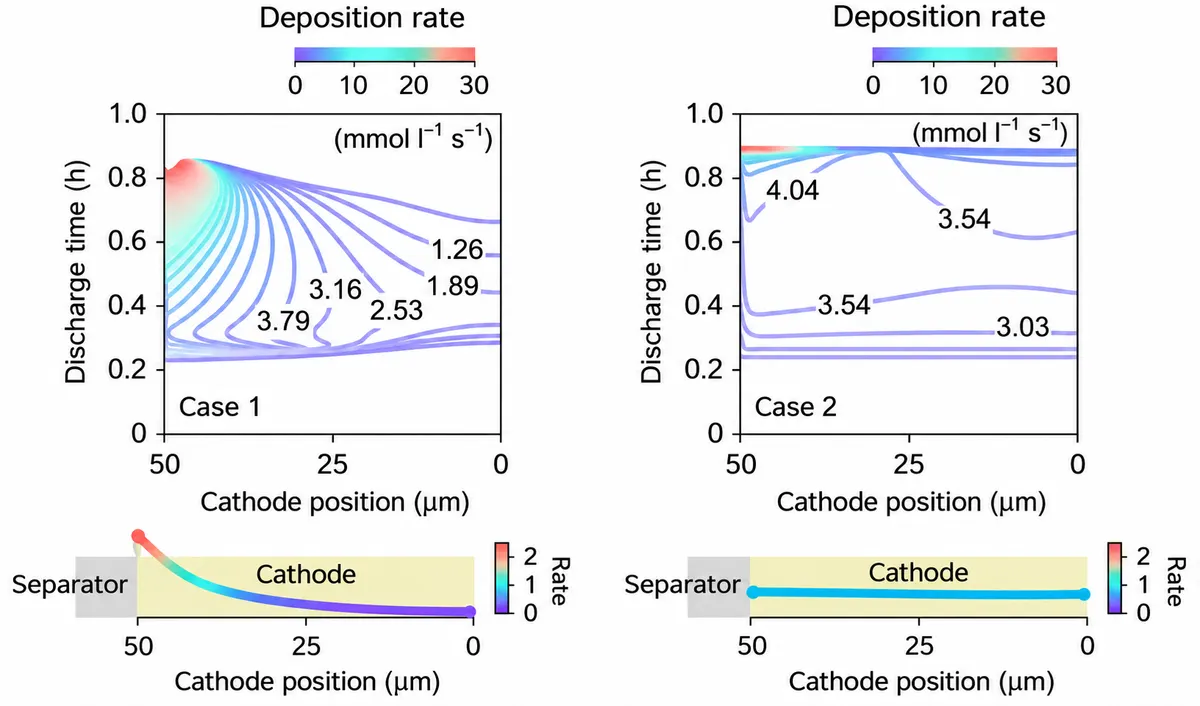
Calculation Purpose
Case Reference
Molecular skeleton programming of premediators in sulfur electrochemistry
Molecular mediators have demonstrated broad applicability in electrolyte chemistry of lithium–sulfur batteries, transforming sulfur conversion from traditional multiphase reactions to highly reactive pathways 1 , 2 , 3 , 4 , 5 , 6 . Despite tremendous efforts to elucidate the mechanistic roles of molecular mediators 7 , 8 , 9 , the influence of molecular skeleton regulation on their mediating effects remains barely understood. Here we propose 2-chloropyrimidine as a potential ‘premediator’ and a model material for molecular skeleton design, which can be in situ activated into a molecular mediator during sulfur reaction progression by means of aromatic nucleophilic substitution, homogeneously inducing a rapid redox loop over the electrode. Integrating quantum chemistry and machine learning, we develop a molecular skeleton programming strategy that illuminates the structure–property relationship between electronic, geometric and site features of side-chain groups and mediating performance, offering control over the activation rate and mediating activity of premediators. The strategy identifies 2-chloro-4-(trifluoromethyl)pyrimidine as a favourable premediator from 196 candidates, enabling lithium–sulfur batteries to achieve an average capacity retention of 81.7% over 800 cycles together with an energy density of 549 Wh kg −1 in a 14.2-Ah-level pouch cell. We expect that our work on molecular skeleton programming may find application in designing functional molecules in broader organic chemical spaces.
Latest Nature report on lithium-sulfur batteries! Quantum chemistry + machine learning design of lithium-sulfur precursors.
Molecular mediators in lithium-sulfur batteries are essentially a class of organic molecular additives added to the electrolyte. They interact with polysulfides to alter sulfur conversion pathways, reduce reaction polarization, and improve the Li₂S deposition process. Past molecular additive design focused more on functional groups, such as their ability to bind polysulfides or promote Li₂S formation. This Nature paper by Zhou Guangmin's team at Tsinghua University's Shenzhen International Graduate School focuses on the molecular skeleton of organic additives: even within the CPyr class of molecules, different substituents and substitution sites simultaneously affect the rate at which the molecule is activated by polysulfides, as well as the charge transfer capability of the activated mediator.
Scan the QR code with WeChat for free consultation
Email: chengyankeji2026@163.com
WeChat QR Code