
机器学习与AIMultiscale Surrogates and Digital Twins

Current Service Inquiry

Data Assimilation and Model Parameter Identification

data assimilation, Bayesian calibration, parameter inversion, phase-field, finite element, fusion of observations, uncertainty
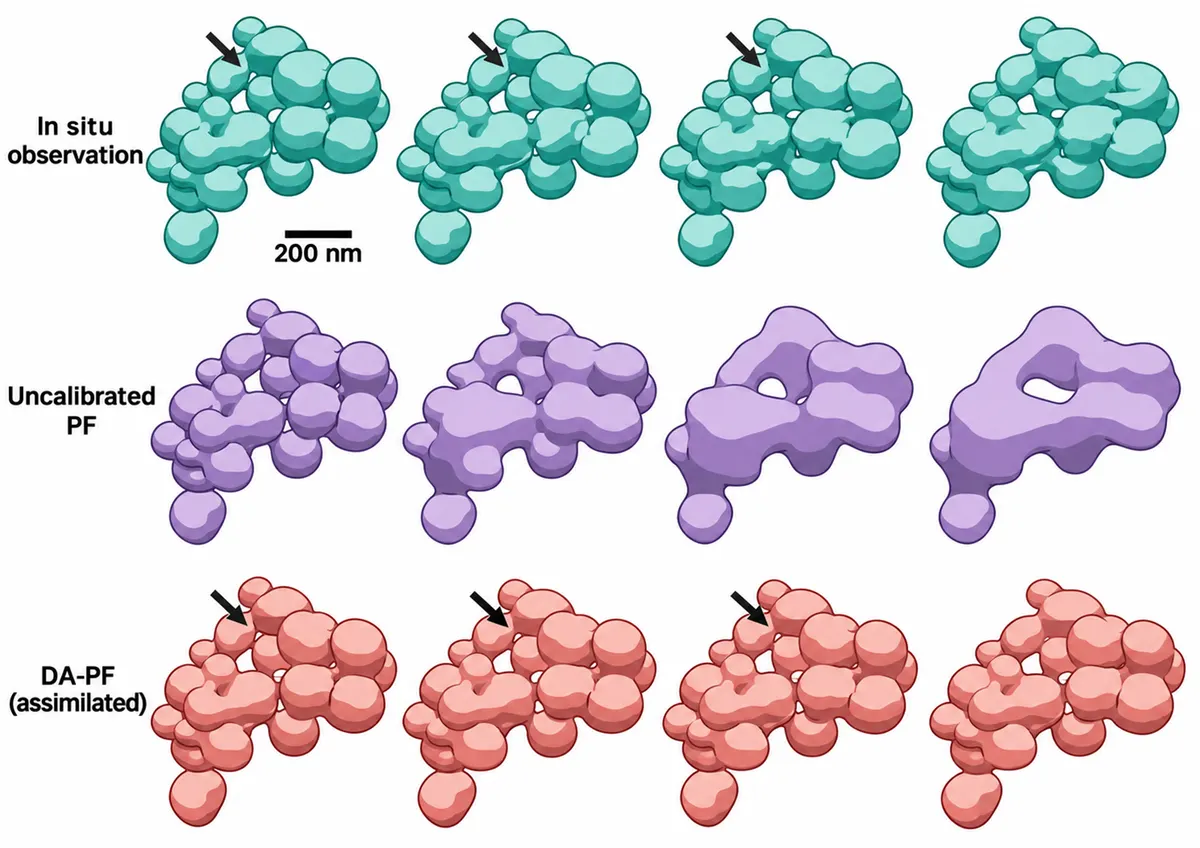
Results Display
Image is for technical case explanation only and does not represent company project results or a specific client case.

Calculation Purpose

Fuse available experiments or high-fidelity calculations into a continuum model, invert key parameters with uncertainty estimates, and improve predictions for the target system.

Case Reference

High-fidelity phase-field simulation of solid-state sintering enabled by Bayesian data assimilation using in situ electron tomography data

Experimental observation methods for understanding industrially important solid-state sintering are essential for the development of new materials and devices. To experimentally characterize solid-state sintering, the limitations posed by the complexity of target materials, experimental equipment, and observation conditions must be overcome. Therefore, hybrid techniques for predicting sintering behavior based on experimental datasets and physics-based simulation models are highly sought after. Herein, we propose a new technique for combining a physics-based model and experimental observation results from solid-state sintering using a nonsequential Bayesian data assimilation (DA) method. The proposed technique assimilates experimental data—obtained using in situ electron tomography/scanning transmission electron microscopy—into the corresponding phase-field (PF) model to enable high-fidelity PF simulations by estimating multiple material parameters included in the PF model. This study demonstrates the inverse estimation of seven parameters, including temperature-dependent diffusion coefficients, from the time-series information on the morphology of sintered nanoparticles observed in situ. The estimated parameters provide the high-fidelity PF simulation to capture the observed solid-state sintering of copper nanoparticles. Thus, this study contributes to the construction of digital twins for solid-state sintering based on DA-integrated PF simulations and in situ observation datasets and deepens our understanding of the sintering process.

Read Article

Scan the QR code with WeChat for free consultation

If you are not sure which plan fits, send us your requirements.

Email: chengyankeji2026@163.com

Contact Us

WeChat QR Code

WeChat QR Code

Not sure which calculation fits? Share your material system and goal, and we will help assess the plan first.

Order now