
Current Service Inquiry
Battery Electrochemical–Thermal Model and State Estimation
Calculation Purpose
Case Reference
Enabling battery digital twins at the industrial scale
Digital twins are cyber-physical systems that fuse real-time sensor data with models to make accurate, asset-specific predictions and optimal decisions. For batteries, this concept has been applied across length scales, from materials to systems. However, a holistic approach with a strong conceptual and mathematical framework is needed for battery digital twins to achieve their full potential at the industrial scale. Developing a standardized and transparent approach for data sharing between stakeholders that respects confidentiality is essential. Industrial battery digital twins also need principled methods to quantify and propagate uncertainty from sensors and models to predictions. Ensuring retention of physical understanding is important for the identification of “stiff” parameters, which require careful measurement. Combined with uncertainty analysis, this can unlock optimal data-driven sensor selection and placement and improved root-cause analysis. However, better physical modeling and sensing approaches for battery manufacturing and thermal runaway are needed. Furthermore, immutability of data is also necessary for industrial uptake, with digital ledger technology providing new avenues of research. We believe that digital twins could be transformative for the current lithium-ion battery technologies and also as an enabler for emerging new battery technologies, optimizing lifetime and value through asset-specific control.
Effect of thermal gradients on inhomogeneous degradation in lithium-ion batteries
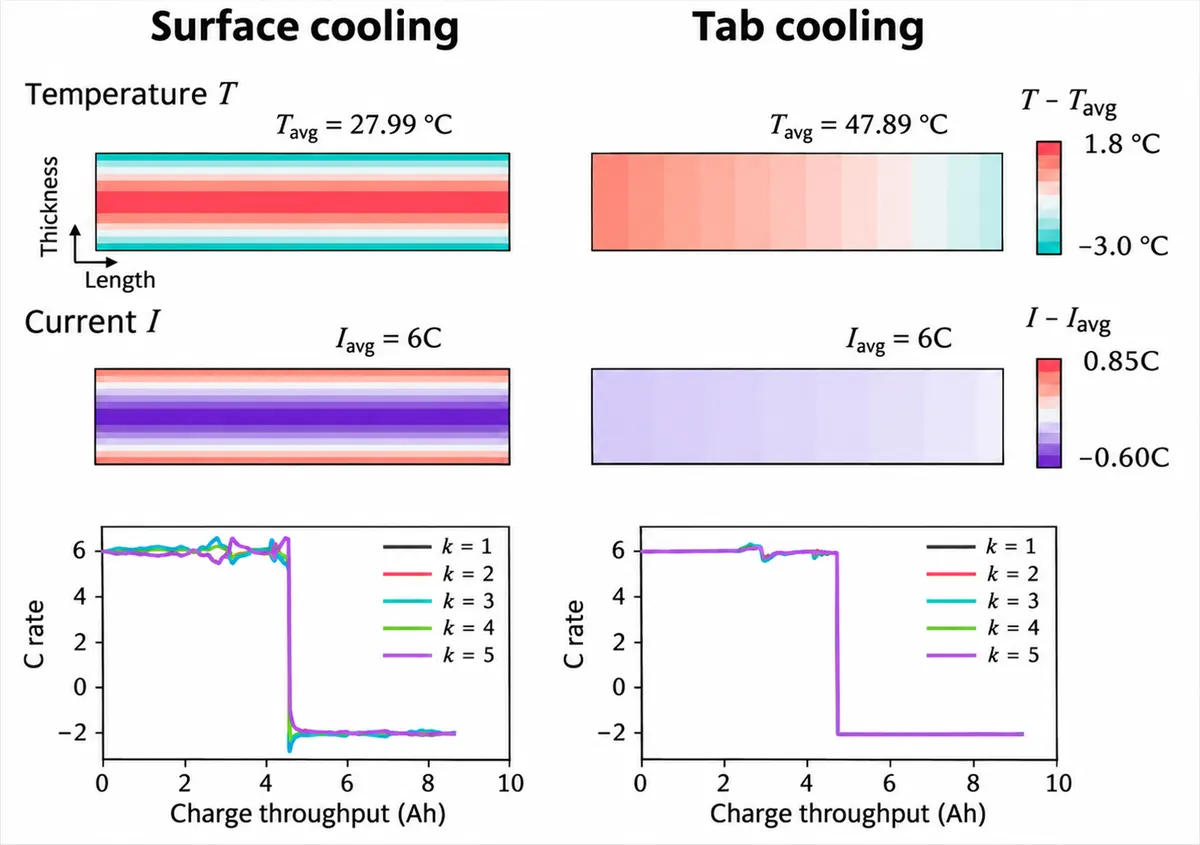
Understanding lithium-ion battery degradation is critical to unlocking their full potential. Poor understanding leads to reduced energy and power density due to over-engineering, or conversely to increased safety risks and failure rates. Thermal management is necessary for all large battery packs, yet experimental studies have shown that the effect of thermal management on degradation is not understood sufficiently. Here we investigated the effect of thermal gradients on inhomogeneous degradation using a validated three-dimensional electro-thermal-degradation model. We have reproduced the effect of thermal gradients on degradation by running a distributed model over hundreds of cycles within hours and reproduced the positive feedback mechanism responsible for the accelerated rate of degradation. Thermal gradients of just 3 °C within the active region of a cell produced sufficient positive feedback to accelerate battery degradation by 300%. Here we show that the effects of inhomogeneous temperature and currents on degradation cannot and should not be ignored. Most attempts to reproduce realistic cell level degradation based upon a lumped model (i.e. no thermal gradients) have suffered from significant overfitting, leading to incorrect conclusions on the rate of degradation.
Scan the QR code with WeChat for free consultation
Email: chengyankeji2026@163.com
WeChat QR Code