
材料加工与表面工艺Laser Processing and Additive Manufacturing

Current Service Inquiry

Rapid Solidification and Microstructure Evolution in Additive Manufacturing

noitulove erutcurtsorcim ,gnilpuoc yrotsih-lamreht ,noitagerges etulos ,secafretni noitacifidilos ,noititepmoc niarg ,ygolohpromDendritic 
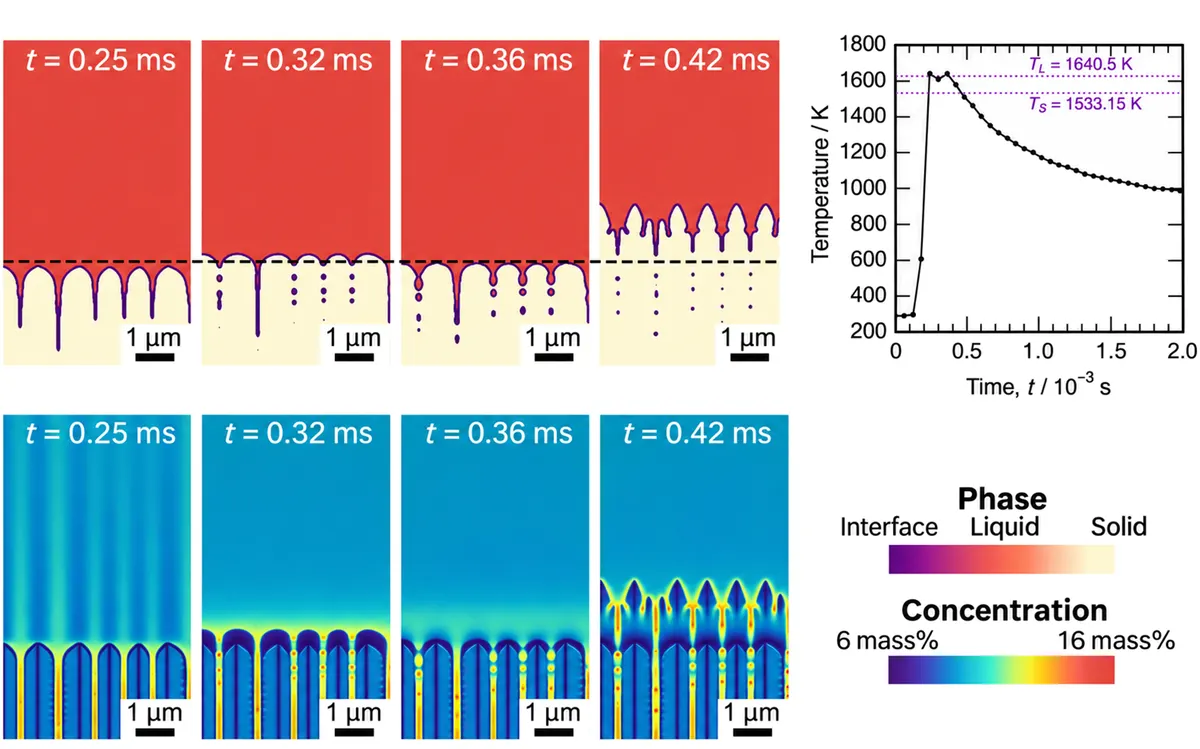
Results Display
Image is for technical case explanation only and does not represent company project results or a specific client case.

Calculation Purpose

.seirotsih lamreht debircserp rednu snoiger noitacifidilos lacol ni noitagerges etulos dna noititepmoc niarg ,htworg citirdnedSimulate 

Case Reference

Solute segregation in a rapidly solidified Hastelloy-X Ni-based superalloy during laser powder bed fusion investigated by phase-field and computational thermal-fluid dynamics simulations

Solute segregation significantly affects material properties and is a critical issue in the laser powder-bed fusion (LPBF) additive manufacturing (AM) of Ni-based superalloys. To the best of our knowledge, this is the first study to demonstrate a computational thermal-fluid dynamics (CtFD) simulation coupled multi-phase-field (MPF) simulation with a multicomponent-composition model of Ni-based superalloy to predict solute segregation under solidification conditions in LPBF. The MPF simulation of the Hastelloy-X superalloy reproduced the experimentally observed submicron-sized cell structure. Significant solute segregations were formed within interdendritic regions during solidification at high cooling rates of up to 10⁸ K s⁻¹, a characteristic feature of LPBF. Solute segregation caused a decrease in the solidus temperature (TS), with a reduction of up to 30.4 K, which increases the risk of liquation cracks during LPBF. In addition, the segregation triggers the formation of carbide phases, which increases the susceptibility to ductility dip cracking. Conversely, we found that the decrease in TS is suppressed at the melt-pool boundary regions, where re-remelting occurs during the stacking of the layer above. Controlling the re-remelting behavior is deemed to be crucial for designing crack-free alloys. Thus, we demonstrated that solute segregation at the various interfacial regions of Ni-based multicomponent alloys can be predicted by the conventional MPF simulation. The design of crack-free Ni-based superalloys can be expedited by MPF simulations of a broad range of element combinations and their concentrations in multicomponent Ni-based superalloys.

Read Article

Scan the QR code with WeChat for free consultation

If you are not sure which plan fits, send us your requirements.

Email: chengyankeji2026@163.com

Contact Us

WeChat QR Code

WeChat QR Code

Not sure which calculation fits? Share your material system and goal, and we will help assess the plan first.

Order now