
材料加工与表面工艺Heat Treatment, Forming and Sintering

Current Service Inquiry

Quenching Phase Transformations and Residual Distortion

noitrotsid ,tnemecalpsid laidar ,sserts laudiser ,yticitsalp decudni-noitamrofsnart ,snoitcarf esahp ,sevrucCooling 
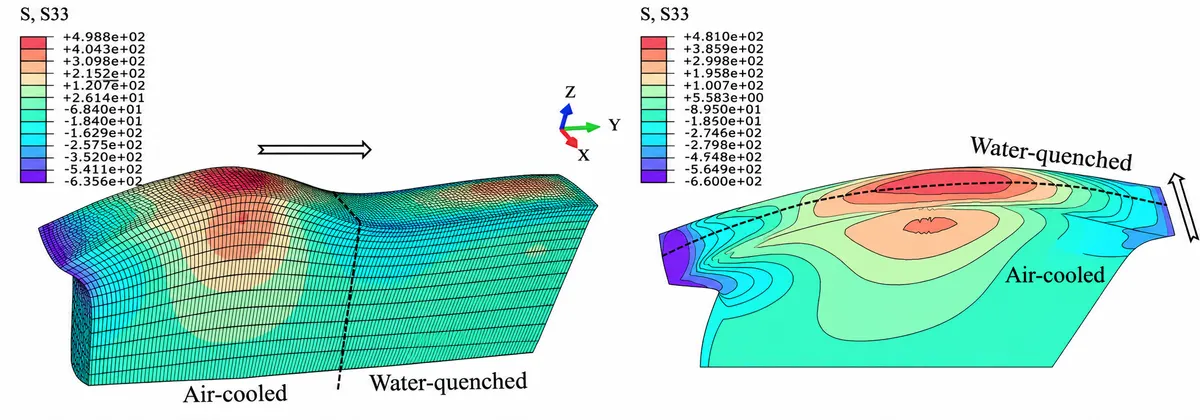
Results Display
Image is for technical case explanation only and does not represent company project results or a specific client case.

Calculation Purpose

.snoitidnoc yradnuob refsnart-taeh dna scitenik noitamrofsnart detarbilac gnisu gnihcneuq gnirud noitrotsid dna sserts laudiser ,snoitcarf esahpCalculate 

Case Reference

Modelling and measurements of thermally induced residual stress in IN718 nickel-based superalloy during non-uniform quenching

Residual stress induced during and as a result of manufacturing processes can have a significant impact on the later stages of manufacturing (e.g., machining), and in-service performance (e.g., resistance to fatigue) of a component. In this work, a novel approach is presented by combining FE based residual stress predictions with experimental verification at scales comparable to industrial components, which is rarely reported. Instrumented plates of IN718 nickel-based superalloys have been water-quenched and air-cooled from solution annealing temperature (980 °C) and the associated cooling curves were measured at specified locations. The cooling curves were used as boundary conditions for inverse calculation of zone-specific heat transfer coefficient (HTC), which is the main parameter to estimate the heat exchange rate between different regions of a heated part and its surrounding environment. The HTCs have then been implemented in an elastic–plastic finite-element model, which included temperature dependant thermo-mechanical properties to predict thermally induced residual stress fields during heterogeneous water/air quenching from. For the verification of the model, identical plates were heterogeneously quenched (half in water and half in air) from 980 °C, both vertically and horizontally, and residual stress was then measured in both plates using the contour method and incremental central hole drilling.

Read Article

Scan the QR code with WeChat for free consultation

If you are not sure which plan fits, send us your requirements.

Email: chengyankeji2026@163.com

Contact Us

WeChat QR Code

WeChat QR Code

Not sure which calculation fits? Share your material system and goal, and we will help assess the plan first.

Order now