
Catalysis
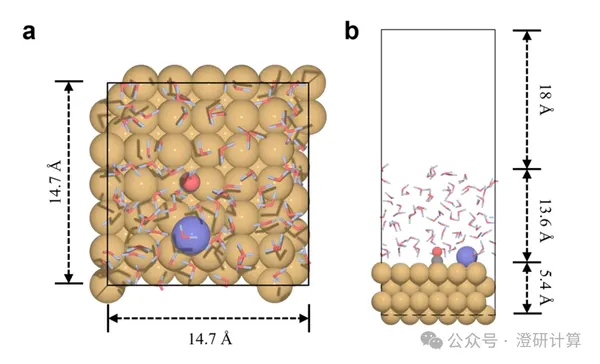
Nature Energy: Theoretical calculations explain a new pathway for I⁻-induced strong acid CO₂RR.
Read OriginalThere has always been a difficult problem to solve when performing CO2 electroreduction under strong acid conditions: acidic media can avoid the accumulation of carbonates and bicarbonates, but at the same time, it will also bring stronger competition for hydrogen evolution and slower C-C coupling, so it is usually not easy to achieve high yields of multi-carbon products.
Read Original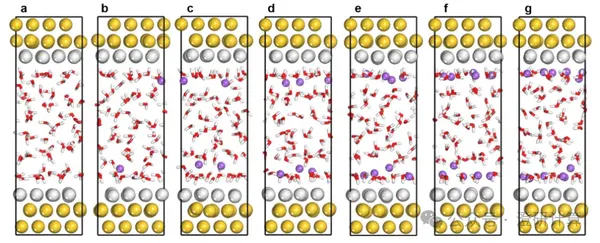
Catalysis
Classic Article on Interfacial Water 1: Li Jianfeng's Computational Interpretation in Nature; In-situ Raman + AIMD Analysis of Pd Interfacial Water Structure and Dissociation Process
Read OriginalInterfacial water is a core foundation for reactions in electrocatalysis. Today, this article introduces a classic work frequently mentioned in the field of interfacial water—an article published in Nature in 2021 by Professor Li Jianfeng's team. The article focuses on interfacial water on single-crystal Pd surfaces under HER conditions, innovatively combining in-situ SHINERS Raman spectroscopy, single-crystal electrochemistry, and theoretical calculations. For the first time, it directly observes the structural change of interfacial water from disorder to order at actual reaction potentials, and further connects this change to the interfacial interaction of Na⁺, the water dissociation process, and HER activity.
Read Original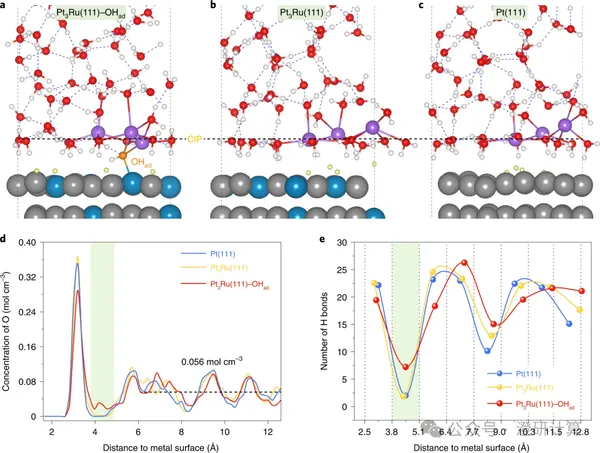
Catalysis
Interfacial Water Classic Article 2: Chen Shengli's Nature Catalysis: Why is HER/HOR slower in alkaline conditions than in acidic conditions?
Read OriginalIn the previous article, we introduced a classic work in the field of interfacial water—an article published in Nature by Professor Li Jianfeng's team, which discovered that the increased proportion of Na⁺ hydrated water (Na·H₂O) at the interface under negative potential enhances HER activity. This article continues in this direction, introducing another classic article on interfacial water: a work published in Nature Catalysis in 2022 by Professor Chen Shengli's team, with Li Peng as the first author. Compared to the previous article, this paper focuses on the pH effect of hydrogen electrocatalysis, explaining why HER/HOR kinetics are slower under alkaline conditions.
Read Original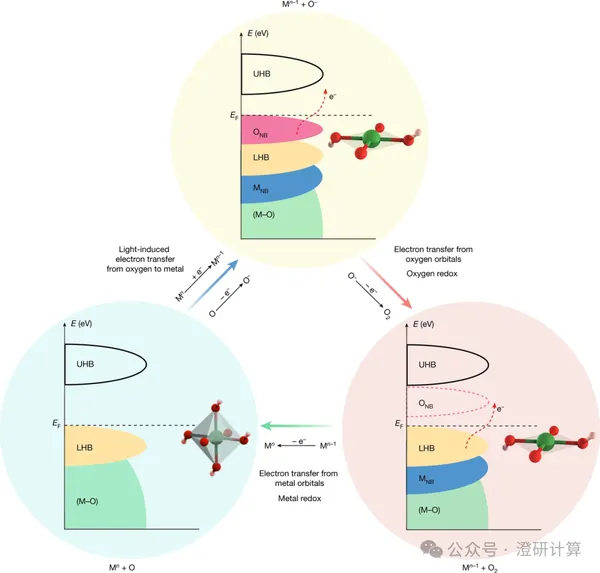
Catalysis
Nature Interpretation: How the Mechanism Diagram is Obtained from Theoretical Calculations: NiO₆↔NiO₄ Reversible Transformation and a New OER Mechanism
Read OriginalTheoretical calculations often yield a wealth of crucial information, but this information is usually scattered across results related to structure, orbitals, and density of states, making it less intuitive to read. Organizing these results into a readily understandable mechanism diagram is a crucial step in publishing high-quality articles. The article published in Nature in 2022 by Junmin Xue's team at the National University of Singapore beautifully illustrates this process. Based on theoretical calculations of the NiO₆ ↔ NiO₄ geometric transition, orbital changes, and reaction energies, the authors created a clear and easy-to-understand schematic diagram of a novel OER mechanism. Today, we'll explain how this mechanism diagram was derived step-by-step from theoretical calculations.
Read Original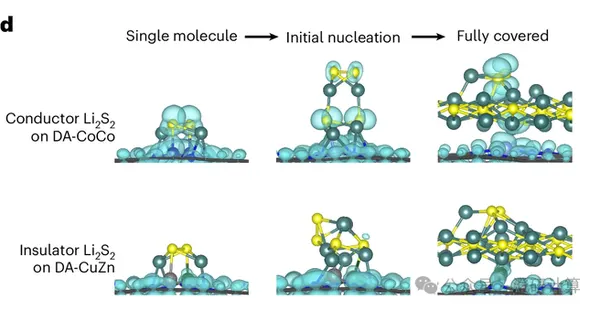
Catalysis / Battery
Nature Catalysis: New Criteria for Lithium-Sulfur Catalysis: Theoretical Calculations Reveal that Energy Barriers Cannot Be the Only Factor in Lithium-Sulfur Reactions
Read OriginalIn the past, when working with lithium-sulfur and lithium-oxygen systems, people were more accustomed to using thermodynamic indicators such as adsorption energy, reaction energy barrier, and free energy to screen catalysts. However, what truly blocks the reaction is often not whether the first step of the reaction can occur, but rather that the accumulation of insulating solid intermediates such as Li₂S₂ and Li₂O₂ blocks electron transport, making it increasingly difficult for subsequent reactions to continue.
Read Original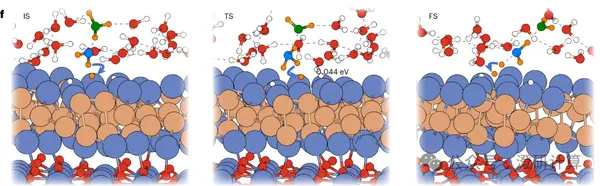
Catalysis
Nature Materials: Thin-shelled RuP2/RuO2 fabricates a near-Pt-like HER, theoretical calculations reveal the interfacial water and proton transfer mechanism
Read OriginalPEM water electrolysis highly relies on Pt and Ir-based electrocatalysts, but the high cost and resource constraints of precious metals limit the large-scale application of such systems. A Nature Materials paper by the teams of Mingfei Shao from Beijing University of Chemical Technology, Lei Wang from the National University of Singapore, and Xin Liu from Harbin University of Science and Technology describes the development of a non-platinum catalyst composite material—a Ru-based core-shell catalyst with a RuO2 core/RuP2 shell—which exhibits HER activity close to that of Pt/C in acidic media, and further validates its application in PEM electrolyzers.
Read Original