
Catalysis
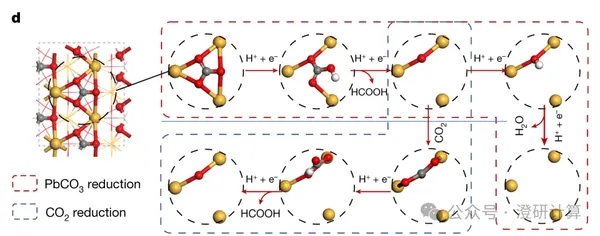
Xia Baoyu, Nature: CO2 to formic acid conversion in acidic PEM stabilizes for 5200 hours; theoretical calculations reveal dynamic Pb–PbCO3 interface mechanism
Read OriginalCO2 electrolysis under PEM conditions must simultaneously achieve high carbon utilization, high selectivity, and long-term stable operation. A Nature paper by Xia Baoyu's team at Huazhong University of Science and Technology demonstrates the direct conversion of CO2 to formic acid in acidic PEM, achieving a formic acid Faradaic efficiency of over 93%, a single-pass conversion rate of approximately 91%, and continuous operation for 5,200 hours at 600 mA cm⁻².
Read Original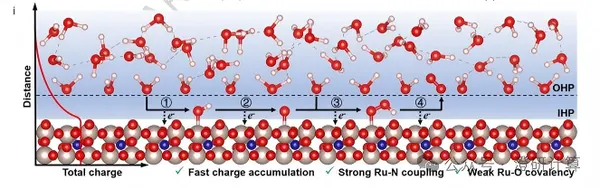
Catalysis
Nat. Commun.: Seven in one, four in communication. PEM electrolysis of water
Read OriginalPEM water electrolysis anodes require long-term oxygen evolution under strong acid and high potential. Ir-based catalysts have good stability, but are expensive and resource-limited; RuO₂ has high activity and relatively low cost, but high-valence Ru is easily further oxidized and dissolved, and the participation of lattice oxygen can also accelerate structural degradation.
Read Original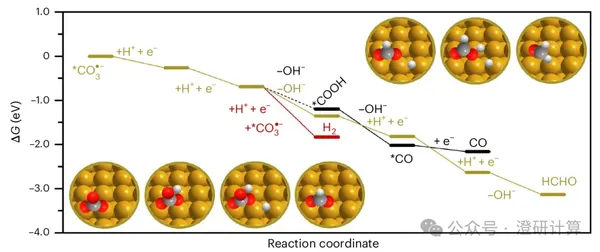
Catalysis
Nature Chemistry: The overlooked carbonate ion in CO₂RR actually restructures the interfacial water
Read OriginalCO₂ electroreduction commonly uses bicarbonate electrolytes. Past discussions of the reaction mechanism have typically focused on CO₂, metal cations, and the catalyst surface, with bicarbonate/carbonate ions often treated as buffer components or sources of carbon loss. This Nature Chemistry paper by Christopher S. Kley's team at the Helmholtz Centre for Materials and Energy in Berlin, Germany, reintroduces the discussion of carbonate ions within the context of interfacial reactions. Using in-situ ATR-SEIRAS, differential electrochemical mass spectrometry (DEMS), isotope labeling, and DFT calculations, the paper demonstrates that in Au-catalyzed CO₂RR, carbonate ions and their radicals can modulate the interfacial water structure, further influencing the competitive relationship between CO₂RR and HER.
Read Original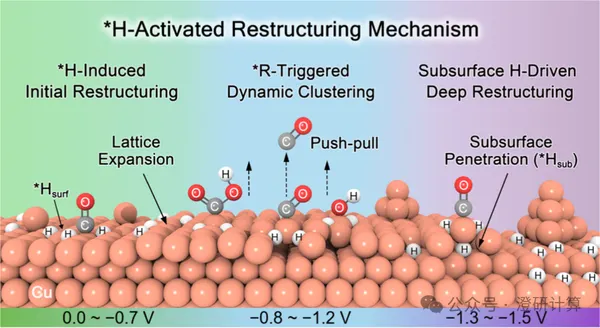
Catalysis
JACS: Why does the CO₂RR catalyst become increasingly coarse with each reaction? Adsorbed hydrogen provides a new explanation
Read OriginalIn the electroreduction of CO₂, the Cu catalyst undergoes simultaneous reaction and reconstruction: the smooth surface gradually roughens, Cu atoms migrate, dissolve, and redeposit, ultimately forming low-coordination clusters. These new structures alter the active sites, directly affecting CO₂ activation, CO coupling, and the formation of multi-carbon products. Previously, Cu reconstruction was often attributed to CO adsorption or reduction potential, but this is insufficient to explain the continuous surface changes occurring over a wide potential range. A JACS paper by the team of Ling Chongyi, Wang Jinlan, and Li Qiang from Southeast University proposes that hydrogen adsorption is the key precursor: it first weakens the Cu–Cu bond and loosens the lattice, then allows intermediates such as CO and COOH to further trigger Cu atom migration and cluster formation.
Read Original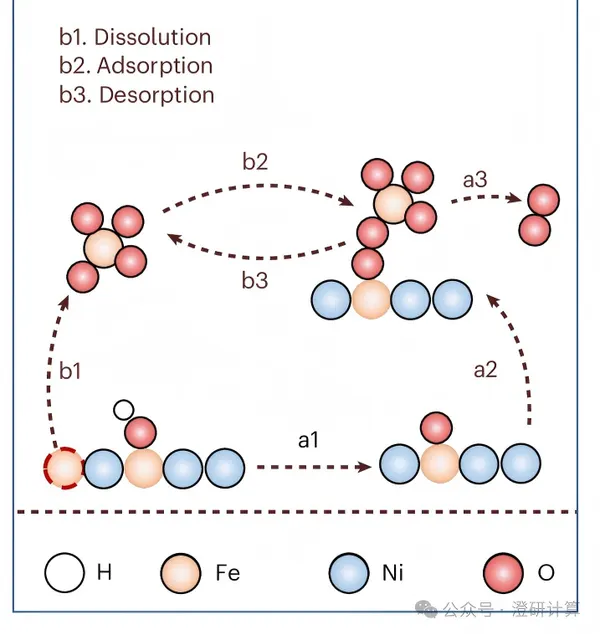
Catalysis
Nature Catalysis: How to change the NiFe OER reaction pathway by neglecting dissolved Fe?
Read OriginalNiFe-based hydroxides are one of the most classic catalytic systems in basic OER (Organic Emission Reduction). Previous understanding of them mainly focused on Fe sites on the solid surface: Fe incorporation into NiOOH forms highly active centers, promoting OER. This Nature Catalysis paper presents a more dynamic interfacial picture: during OER, the NiFe catalyst undergoes Fe dissolution and redeposition, with some dissolved Fe species transforming into FeO₄²⁻, which then participates as a molecular co-catalyst in the key O–O bonding step. Theoretical calculations further illustrate that surface *O can synergistically form the *OOFeO₃ intermediate with FeO₄²⁻ in solution, shifting OER from the traditional solid-surface AEM pathway to a solid-molecular synergistic pathway.
Read Original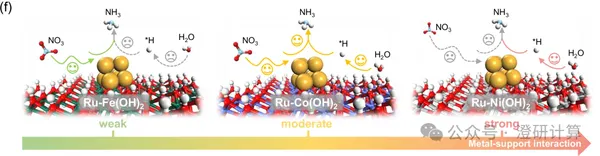
Catalysis
Nat. Commun.: Moderate metal-support interactions, DFT explanation of efficient Ru-Co(OH)₂ nitrate ammonia production
Read OriginalNitrate electroreduction for ammonia production converts NO₃⁻ in wastewater into NH₃, simultaneously achieving pollutant treatment and resource recovery. However, most catalysts require negative potential operation, resulting in high energy consumption and limited energy efficiency. This Nature Communications paper describes three types of catalysts constructed by loading Ru clusters onto different metal hydroxide supports using a self-corrosion strategy: Ru-Co(OH)₂, Ru-Ni(OH)₂, and Ru-Fe(OH)₂. The results show that Ru-Co(OH)₂ exhibits moderate metal-support interactions, simultaneously optimizing NO₃⁻ adsorption and interfacial water splitting, achieving highly efficient NO₃⁻ reduction for ammonia production at positive potential. Theoretical calculations further illustrate that the advantage of Ru-Co(OH)₂ comes from the “moderate interaction”: the Ru site provides suitable NO₃⁻ adsorption, and Co(OH)₂ promotes H₂O dissociation and *H supply, thereby accelerating the continuous hydrogenation process from NO₃⁻ to NH₃.
Read Original