
Battery / Catalysis
Xu Zhichuan, Nature Chemistry: Spin-regulated N–N bonding, magnetization promotes ammonia oxidation
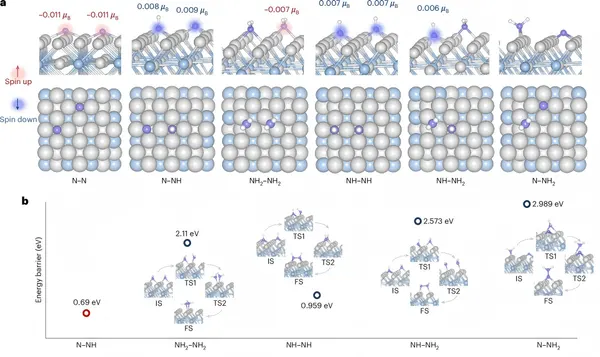
Read OriginalThe electrochemical ammonia oxidation reaction (AOR, NH₃ → N₂) can be used in ammonia fuel cells, ammonia decomposition for hydrogen production, and ammonia energy conversion processes. For Pt-based catalysts, AOR typically involves partial dehydrogenation of NH₃ to form NHx intermediates such as *NH₂, *NH, and *N. These intermediates then undergo NHx–NHy coupling to form N–N bonds, and finally, further dehydrogenation to generate N₂. In this Nature Chemistry article, the authors argue that the most challenging step in AOR is the dimerization and bonding process between the NHx intermediates, a process that can be influenced by the spin state of the catalyst surface.
Read Original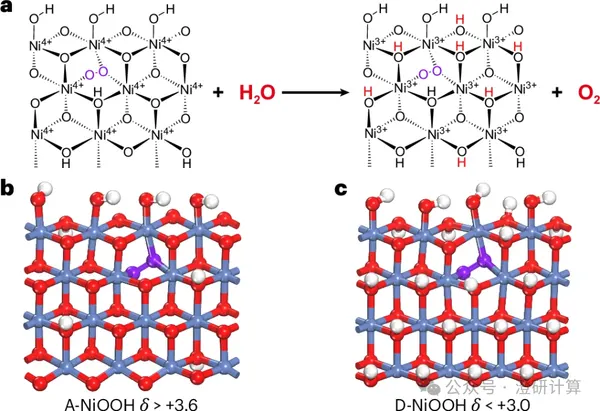
Catalysis
Nature Chemistry: Can it still produce oxygen after a power outage? The long-lived NiOOH active phase reveals the charge storage mechanism of Ni⁴⁺
Read OriginalNickel-based OER catalysts are typically reconstructed into NiOOH, but the true active structure and O–O bonding mechanism remain unclear. This paper isolates a long-lived active NiOOH phase (A-NiOOH) from OER conditions using rapid freeze-drying and freezing methods, revealing its continuous oxygen release in pure water at room temperature without an applied potential. The authors further demonstrate that A-NiOOH is a Ni⁴⁺-rich γ-NiOOH active phase with a stable Ni–O–O–Ni₂ structure in the bulk phase; the charge stored in Ni⁴⁺ can migrate to the surface, driving lattice oxygen release and subsequent water molecule oxidation. Theoretical calculations construct an A-NiOOH structural model, and calculations using AEM/LOM free energy comparisons, proton transfer, and SOE pathways explain how the stored charge in the bulk phase drives water oxidation.
Read Original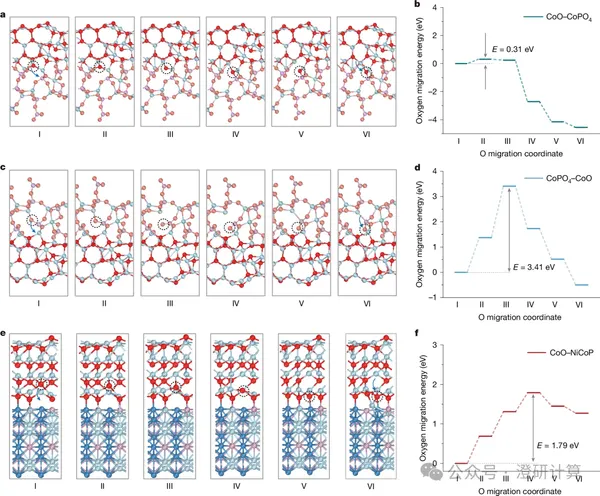
Catalysis
Nature's main journal calculations (CI-NEB) reveal the dynamic passivation mechanism of a 10,000-hour intermittent seawater electrolysis cathode
Read OriginalRenewable energy power supply is intermittent, and frequent start-ups and shutdowns cause the cathode of seawater electrolysis to rapidly rise from the reduction potential to a high potential, leading to catalyst oxidation and exacerbating the adsorption and corrosion of halide ions such as Cl−. Based on this, Sun Xiaoming and Zhou Daojin from Beijing University of Chemical Technology, along with Liu Bin from City University of Hong Kong, designed a NiCoP–Cr2O3 cathode. This cathode forms a multi-layered passivation structure in situ during shutdown and restores hydrogen evolution activity upon restarting, achieving 10,000 hours of intermittent alkaline seawater electrolysis. Theoretical calculations further analyzed the oxidation sequence of Co, P, and Ni, oxygen migration within the passivation layer, the inhibition of Cl− adsorption by phosphate, and the promoting effect of Cr2O3 on alkaline hydrogen evolution kinetics.
Read Original