
Battery
Nature Catalysis: Cation-doped ZnS reveals the volcano-like relationship between adsorption and activity in lithium-sulfur catalysts
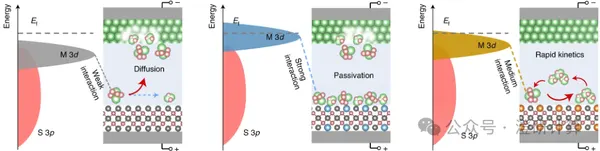
Read OriginalIn lithium-sulfur batteries, slow polysulfide conversion exacerbates the shuttle effect and capacity decay. This paper uses ZnS as the parent material and introduces Mn, Fe, Co, Ni, and Cu cations for doping, systematically regulating the polysulfide adsorption intensity. A volcano-like relationship was found between catalytic activity and adsorption intensity, with Co₀.₁₂₅Zn₀.₈₇₅S exhibiting the optimal catalytic effect. Theoretical calculations using DFT adsorption energy, d-band centers, Bader charge, differential charge density, COHP/iCOHP, and a microkinetic model demonstrate that moderate adsorption intensity is beneficial for simultaneously promoting Li₂S₄ conversion and Li₂S₂/Li₂S desorption.
Read Original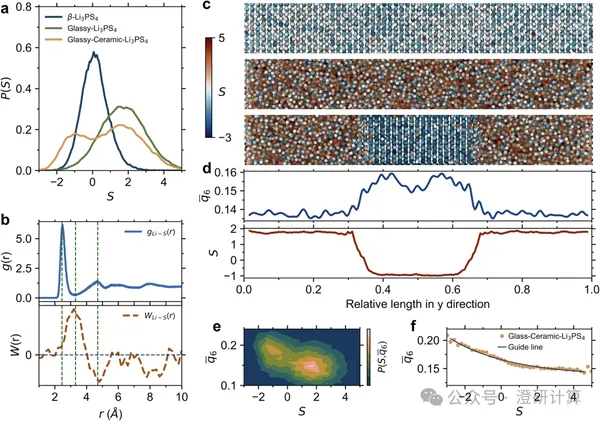
Battery
Nat. Commun.: How do disordered structures accelerate Li⁺ transport? Deep learning potential reveals the mechanism in solid-state electrolytes
Read OriginalGlassy and glass-ceramic solid electrolytes exhibit high ionic conductivity, but the influence of disordered structure on Li⁺ migration remains poorly understood at the atomic scale. This paper establishes a deep learning potential function for the Li–P–S system, comparing crystalline, glassy, and glass-ceramic Li₃PS₄ states. The results show that disordered glassy and interfacial phases can promote Li⁺ hopping, interphase exchange, and intracrystalline co-diffusion. Furthermore, the authors use a machine learning softness descriptor to link the degree of local structural disorder with Li⁺ migration capability, explaining why disordered structures enhance room-temperature ionic conductivity.
Read Original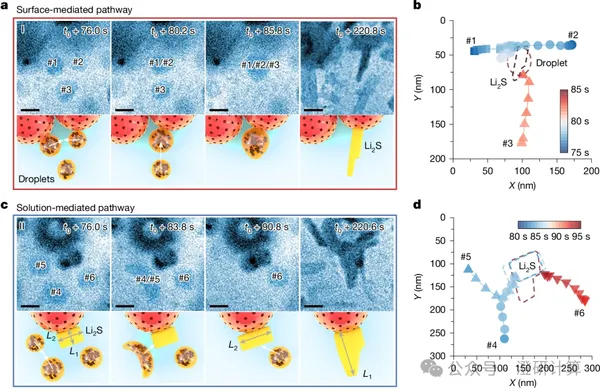
Battery
Nature: In lithium-sulfur batteries, high concentrations of polysulfides allow insulating Li₂S to break through passivation and continue to grow
Read OriginalHigh sulfur loading and lean electrolyte conditions can improve the energy density of lithium-sulfur batteries, but they also lead to a sharp increase in the concentration of polysulfides at the interface, resulting in a reaction pathway different from that of conventional dilute solution systems. This paper uses in-situ liquid phase electron microscopy to directly observe that high-concentration polysulfides form a high-concentration interfacial layer near the catalyst, which further separates into a droplet-like dense phase. These droplets first induce Li₂S nucleation on the catalyst surface, and then adsorb onto existing nuclei, continuing to drive Li₂S growth. Theoretical calculations further show that polysulfide aggregation causes structural distortion, bandgap narrowing, and enhanced Sp–Ru d orbital hybridization, thereby promoting collective charge transfer at the high-concentration interface.
Read Original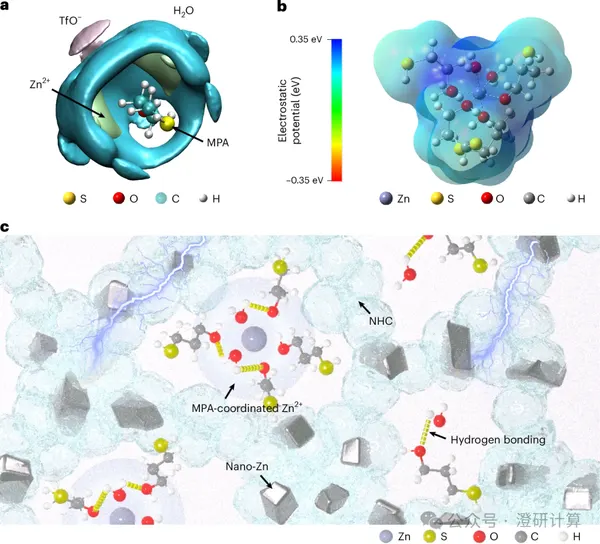
Battery
Nature Energy: A New Architecture for Aqueous Batteries! Flowing Zinc Slurry Overcomes Dendrite and Particle Aggregation
Read OriginalWhile the energy storage capacity of flowing zinc slurry can be adjusted using external storage tanks, zinc particles are prone to aggregation, sedimentation, and overgrowth during circulation, ultimately causing the slurry to lose its fluidity. This paper proposes a flowing zinc slurry composed of nano-zinc, a nano-hollow carbon conductive network, PVP dispersant, and 3-mercapto-1-propanol (MPA) ligand. The ligand confines and stabilizes zinc nanocrystals, achieving uniform and reversible Zn/Zn²⁺ conversion. The optimized zinc slurry achieved a coulombic efficiency of 99.94% and operated continuously for 5128 hours. Matching it with MnO₂ and O₂ cathodes further validated its application potential in long-cycle and continuous discharge energy storage. Theoretical calculations, using molecular dynamics, DFT binding energy and adsorption energy calculations, electrostatic potential analysis, and finite element simulations, explain how MPA regulates the Zn²⁺ solvation and zinc deposition processes.
Read Original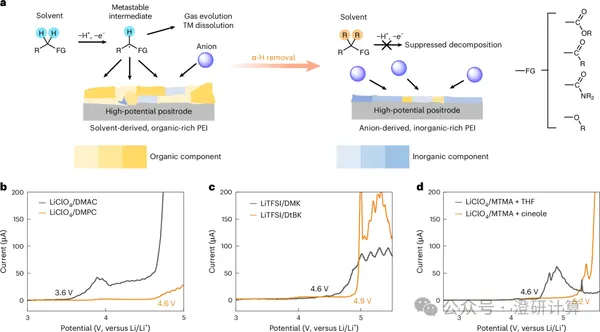
Battery
Nat. Chem.: Removing α-H allows for stable operation at 5.6 V without fluorine! A new design for high-voltage lithium battery solvents
Read OriginalHigh-voltage lithium metal batteries require electrolytes to remain stable above 4.6 V, but conventional non-fluorinated solvents are prone to oxidation, while high-concentration salts and fluorinated solvents face issues related to cost, environmental impact, and decomposition byproducts. This paper discovers that the main failure pathway of carboxylic acid ester solvents is α-oxidation triggered by carbonyl α-H. The authors designed a non-fluorinated solvent, trimethylmethyl acetate (MTMA), by replacing all α-H atoms in methyl acetate (MA) with methyl groups, blocking solvent oxidation, and applied it to high-voltage Li/LRMO batteries and ampere-hour-level pouch cells. Theoretical calculations show that MA radical cations most readily form stable radicals through α-C–H cleavage; removing α-H shuts down this low-energy decomposition pathway. Even with higher HOMO values for MTMA and other α-H-free molecules, their actual oxidation stability is still significantly improved.
Read Original