
Battery
Reviewers requested supplementary calculations? Nat. Commun. Reviewer Comments Interpretation – Two Rounds of Responses and In-Depth Supplementary Calculations
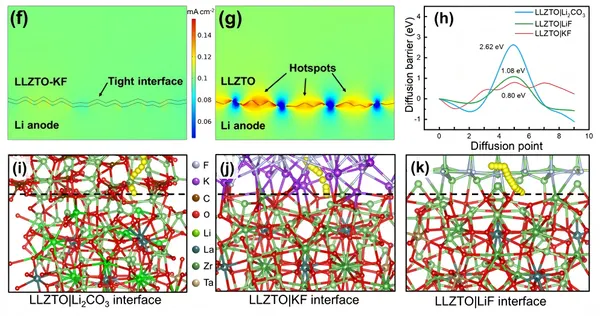
Read OriginalWhen submitting to top journals, the most difficult step is often not producing the results, but rather providing sufficiently strong mechanistic evidence when reviewers press for "why." When reviewers from top journals raise rigorous questions about your physical mechanisms, how can theoretical calculations help you revive your work? This article will analyze a study on LLZTO solid electrolyte modification published in Nature Communications by Professor Liu Wei's team at ShanghaiTech University, along with their reviewers' comments. It will examine how the authors, facing continuous questioning during the review process, strengthened their arguments layer by layer, and, through first-principles calculations (DFT) and finite element simulations (COMSOL), gradually integrated the initially scattered results into a self-consistent and complete mechanistic loop.
Read Original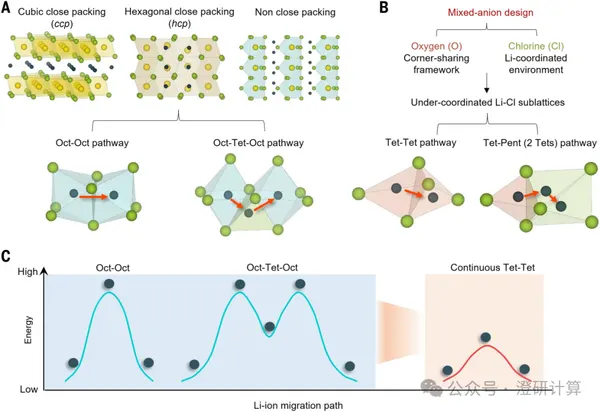
Battery
Sun Xueliang in Science: From experimental characterization to structural modeling, how should the structure of novel solid electrolyte materials be determined?
Read OriginalThe successful synthesis of a new material does not mean the problem is solved; the real difficulties often lie ahead: What will it look like? How will its structure be determined? If there isn't even a ready-made crystal model, how can theoretical calculations be carried out?
Read Original![[Diffusion within pores] Narrower pores, faster diffusion? Molecular dynamics reveals a "super high-speed rail" diffusion mechanism in nanopores. (Zheng Anmin, Nature Communications)](https://img.chengyankeji.cn/uploads/optimized/1776756402547-20260324-w600.webp)
Porous materials and separation transport
[Diffusion within pores] Narrower pores, faster diffusion? Molecular dynamics reveals a "super high-speed rail" diffusion mechanism in nanopores. (Zheng Anmin, Nature Communications)
Read OriginalIn the study of porous materials, especially molecular sieves, diffusion rate often directly determines material properties. Our intuition is usually that the narrower the pores, the stronger the confinement, and the slower the molecular diffusion should be.
However, this work by Zheng Anmin's team, published in Nature Communications, overturns this understanding: for long-chain molecules, smaller pores actually lead to faster diffusion.
Read OriginalHowever, this work by Zheng Anmin's team, published in Nature Communications, overturns this understanding: for long-chain molecules, smaller pores actually lead to faster diffusion.
Porous materials and separation transport / Ion Diffusion
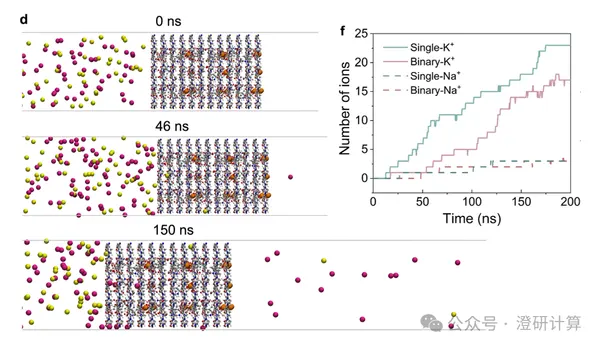
COF can actually perform these calculations? Nat. Commun. uses DFT and molecular dynamics to explain the K+/Na+ separation mechanism.
Read OriginalThe 2025 Nobel Prize in Chemistry was awarded to MOFs, bringing greater attention to framework materials like MOFs and COFs. What theoretical calculations can be performed on MOF/COF materials?
Read Original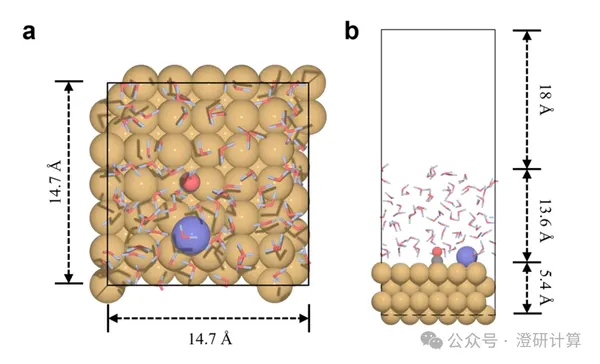
Catalysis
Nature Energy: Theoretical calculations explain a new pathway for I⁻-induced strong acid CO₂RR.
Read OriginalThere has always been a difficult problem to solve when performing CO2 electroreduction under strong acid conditions: acidic media can avoid the accumulation of carbonates and bicarbonates, but at the same time, it will also bring stronger competition for hydrogen evolution and slower C-C coupling, so it is usually not easy to achieve high yields of multi-carbon products.
Read Original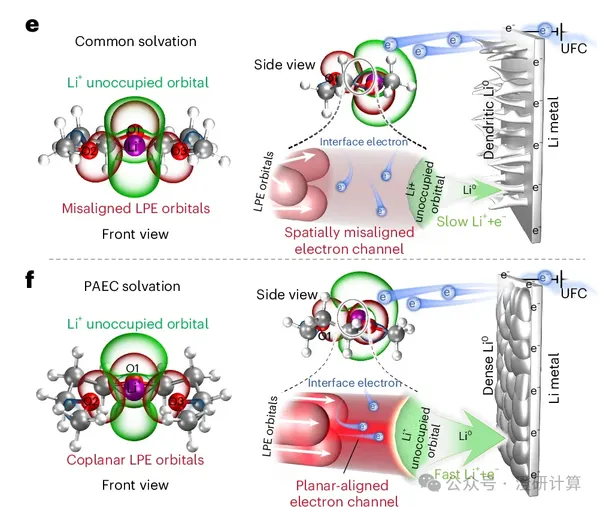
Battery
Nature Energy: How to make changing a solvent molecule sound sophisticated? From DFT, MD to CDFT, see how theoretical calculations can elevate the quality of your papers.
Read OriginalMany electrolyte research papers, on the surface, seem to focus on just one thing: changing a solvent molecule.
However, those that truly get published in high-level journals are rarely as simple as "I changed the molecule, so the performance is better." Rather, they demonstrate whether the authors can elevate this molecular change to a new structural concept, a new interface mechanism, and a complete, verifiable chain of theoretical calculations.
Read OriginalHowever, those that truly get published in high-level journals are rarely as simple as "I changed the molecule, so the performance is better." Rather, they demonstrate whether the authors can elevate this molecular change to a new structural concept, a new interface mechanism, and a complete, verifiable chain of theoretical calculations.