
Battery
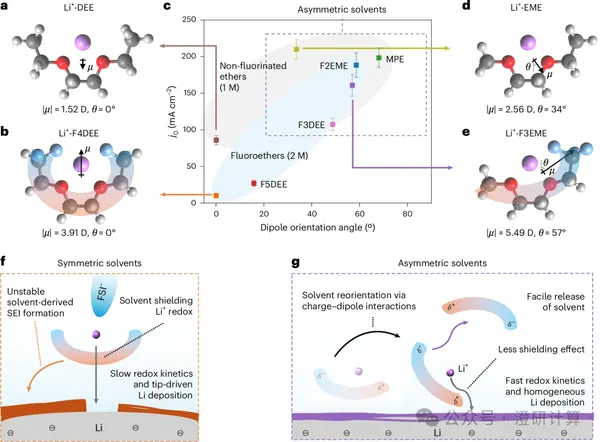
Nature Energy: Cui Yi & Bao Zhenan propose asymmetric ether solvents to achieve high-rate lithium metal batteries
Read OriginalHigh-rate lithium metal batteries require addressing two key challenges: rapid Li⁺/Li⁰ reaction kinetics and sufficiently stable SEI (Sediment Injection). This Nature Energy paper proposes an asymmetric ether solvent strategy, starting with electrolyte solvent molecule design. Compared to symmetric ether solvents, asymmetric ethers can increase the exchange current density and accelerate Li deposition/stripping kinetics.
Read Original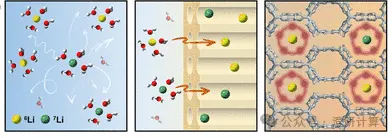
Battery
JACS: COF capture of ⁶Li, diffusion is more critical than binding
Read Original⁶Li is an important resource for tritium fusion breeding, but ⁶Li and ⁷Li have almost identical chemical properties, making their separation very difficult. Traditional adsorption separation usually depends on the binding strength of the ligand to the isotope. However, this JACS paper points out that in crown ether modified COFs, the truly preferential adsorption is not the thermodynamically more stable ⁷Li, but rather ⁶Li, which diffuses and desolvates more quickly. The authors constructed an AB15C5 crown ether modified COF and experimentally found that the adsorbed phase was enriched with ⁶Li; theoretical calculations show that AB15C5 has a slight thermodynamic preference for ⁷Li, but ⁶Li has faster diffusion and lower desolvation resistance, thus preferentially occupying adsorption sites.
Read Original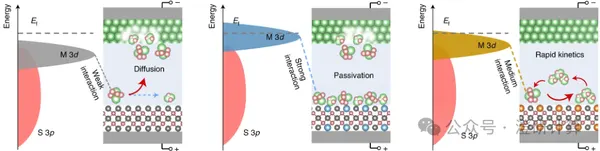
Battery
Nature Catalysis: Cation-doped ZnS reveals the volcano-like relationship between adsorption and activity in lithium-sulfur catalysts
Read OriginalIn lithium-sulfur batteries, slow polysulfide conversion exacerbates the shuttle effect and capacity decay. This paper uses ZnS as the parent material and introduces Mn, Fe, Co, Ni, and Cu cations for doping, systematically regulating the polysulfide adsorption intensity. A volcano-like relationship was found between catalytic activity and adsorption intensity, with Co₀.₁₂₅Zn₀.₈₇₅S exhibiting the optimal catalytic effect. Theoretical calculations using DFT adsorption energy, d-band centers, Bader charge, differential charge density, COHP/iCOHP, and a microkinetic model demonstrate that moderate adsorption intensity is beneficial for simultaneously promoting Li₂S₄ conversion and Li₂S₂/Li₂S desorption.
Read Original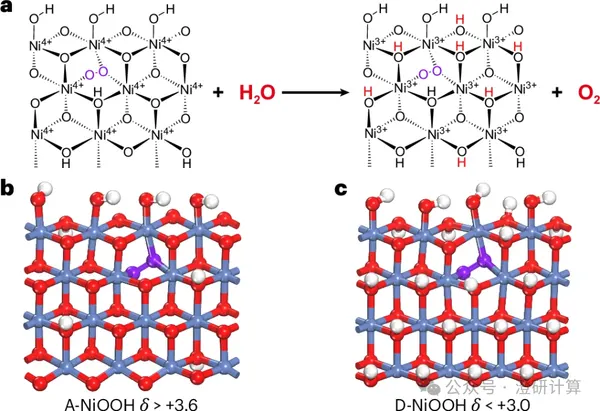
Catalysis
Nature Chemistry: Can it still produce oxygen after a power outage? The long-lived NiOOH active phase reveals the charge storage mechanism of Ni⁴⁺
Read OriginalNickel-based OER catalysts are typically reconstructed into NiOOH, but the true active structure and O–O bonding mechanism remain unclear. This paper isolates a long-lived active NiOOH phase (A-NiOOH) from OER conditions using rapid freeze-drying and freezing methods, revealing its continuous oxygen release in pure water at room temperature without an applied potential. The authors further demonstrate that A-NiOOH is a Ni⁴⁺-rich γ-NiOOH active phase with a stable Ni–O–O–Ni₂ structure in the bulk phase; the charge stored in Ni⁴⁺ can migrate to the surface, driving lattice oxygen release and subsequent water molecule oxidation. Theoretical calculations construct an A-NiOOH structural model, and calculations using AEM/LOM free energy comparisons, proton transfer, and SOE pathways explain how the stored charge in the bulk phase drives water oxidation.
Read Original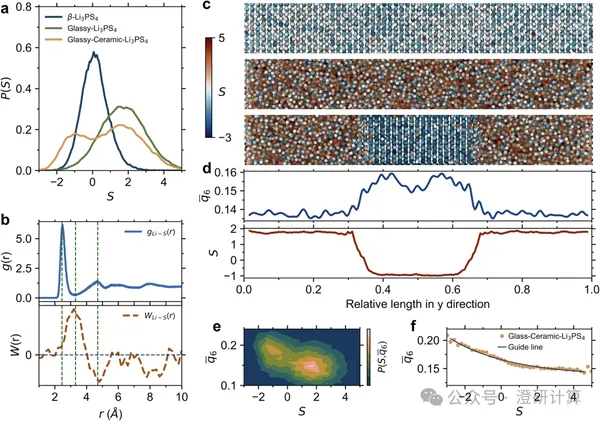
Battery
Nat. Commun.: How do disordered structures accelerate Li⁺ transport? Deep learning potential reveals the mechanism in solid-state electrolytes
Read OriginalGlassy and glass-ceramic solid electrolytes exhibit high ionic conductivity, but the influence of disordered structure on Li⁺ migration remains poorly understood at the atomic scale. This paper establishes a deep learning potential function for the Li–P–S system, comparing crystalline, glassy, and glass-ceramic Li₃PS₄ states. The results show that disordered glassy and interfacial phases can promote Li⁺ hopping, interphase exchange, and intracrystalline co-diffusion. Furthermore, the authors use a machine learning softness descriptor to link the degree of local structural disorder with Li⁺ migration capability, explaining why disordered structures enhance room-temperature ionic conductivity.
Read Original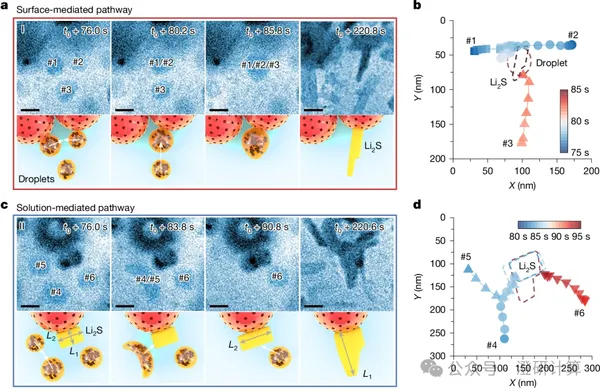
Battery
Nature: In lithium-sulfur batteries, high concentrations of polysulfides allow insulating Li₂S to break through passivation and continue to grow
Read OriginalHigh sulfur loading and lean electrolyte conditions can improve the energy density of lithium-sulfur batteries, but they also lead to a sharp increase in the concentration of polysulfides at the interface, resulting in a reaction pathway different from that of conventional dilute solution systems. This paper uses in-situ liquid phase electron microscopy to directly observe that high-concentration polysulfides form a high-concentration interfacial layer near the catalyst, which further separates into a droplet-like dense phase. These droplets first induce Li₂S nucleation on the catalyst surface, and then adsorb onto existing nuclei, continuing to drive Li₂S growth. Theoretical calculations further show that polysulfide aggregation causes structural distortion, bandgap narrowing, and enhanced Sp–Ru d orbital hybridization, thereby promoting collective charge transfer at the high-concentration interface.
Read Original