
Catalysis
Nature Catalysis: How to change the NiFe OER reaction pathway by neglecting dissolved Fe?
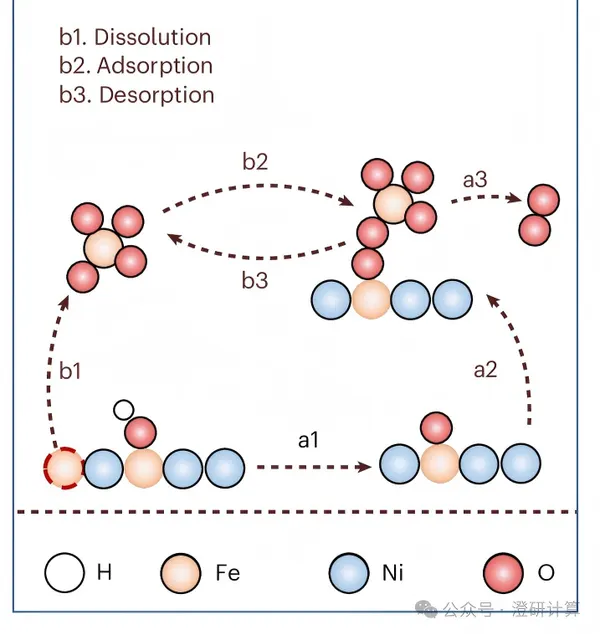
Read OriginalNiFe-based hydroxides are one of the most classic catalytic systems in basic OER (Organic Emission Reduction). Previous understanding of them mainly focused on Fe sites on the solid surface: Fe incorporation into NiOOH forms highly active centers, promoting OER. This Nature Catalysis paper presents a more dynamic interfacial picture: during OER, the NiFe catalyst undergoes Fe dissolution and redeposition, with some dissolved Fe species transforming into FeO₄²⁻, which then participates as a molecular co-catalyst in the key O–O bonding step. Theoretical calculations further illustrate that surface *O can synergistically form the *OOFeO₃ intermediate with FeO₄²⁻ in solution, shifting OER from the traditional solid-surface AEM pathway to a solid-molecular synergistic pathway.
Read Original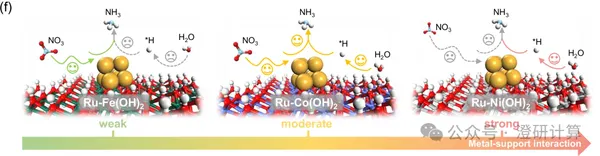
Catalysis
Nat. Commun.: Moderate metal-support interactions, DFT explanation of efficient Ru-Co(OH)₂ nitrate ammonia production
Read OriginalNitrate electroreduction for ammonia production converts NO₃⁻ in wastewater into NH₃, simultaneously achieving pollutant treatment and resource recovery. However, most catalysts require negative potential operation, resulting in high energy consumption and limited energy efficiency. This Nature Communications paper describes three types of catalysts constructed by loading Ru clusters onto different metal hydroxide supports using a self-corrosion strategy: Ru-Co(OH)₂, Ru-Ni(OH)₂, and Ru-Fe(OH)₂. The results show that Ru-Co(OH)₂ exhibits moderate metal-support interactions, simultaneously optimizing NO₃⁻ adsorption and interfacial water splitting, achieving highly efficient NO₃⁻ reduction for ammonia production at positive potential. Theoretical calculations further illustrate that the advantage of Ru-Co(OH)₂ comes from the “moderate interaction”: the Ru site provides suitable NO₃⁻ adsorption, and Co(OH)₂ promotes H₂O dissociation and *H supply, thereby accelerating the continuous hydrogenation process from NO₃⁻ to NH₃.
Read Original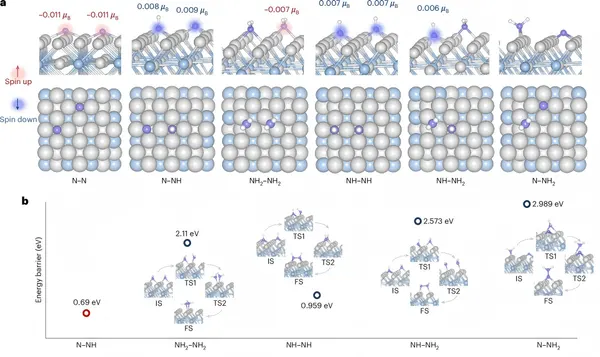
Battery / Catalysis
Xu Zhichuan, Nature Chemistry: Spin-regulated N–N bonding, magnetization promotes ammonia oxidation
Read OriginalThe electrochemical ammonia oxidation reaction (AOR, NH₃ → N₂) can be used in ammonia fuel cells, ammonia decomposition for hydrogen production, and ammonia energy conversion processes. For Pt-based catalysts, AOR typically involves partial dehydrogenation of NH₃ to form NHx intermediates such as *NH₂, *NH, and *N. These intermediates then undergo NHx–NHy coupling to form N–N bonds, and finally, further dehydrogenation to generate N₂. In this Nature Chemistry article, the authors argue that the most challenging step in AOR is the dimerization and bonding process between the NHx intermediates, a process that can be influenced by the spin state of the catalyst surface.
Read Original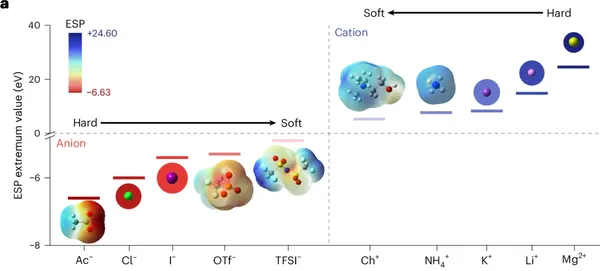
Battery
Aqueous Batteries (Nature Chemistry): Hard and Soft Ions Modulate Zn²⁺ Stability, Electrode Potential Shift by 0.6 V
Read OriginalAdding different anions/cations to the electrolyte significantly alters the redox potential of the metal electrode. This Nature Chemistry article points out that this change can be explained by the hard and soft properties of ions and long-range coulombic interactions. The anions and cations surrounding Zn²⁺ themselves also change the stability of Zn²⁺ through their hard and soft acid-base properties, thereby altering the Zn/Zn²⁺ potential.
Read Original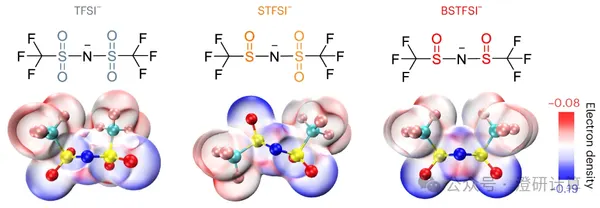
Battery
Nature Energy: Asymmetric lithium salt regulation of CEI, Tsinghua University's Liu Kai team achieves lithium metal battery under extreme conditions
Read OriginalUnder high voltage, fast charging, and low temperature conditions, batteries are primarily limited by the positive electrode CEI: the electrolyte is prone to continuous oxidation and decomposition, and Li⁺ desolvation and charge transfer also slow down. This Nature Energy paper, starting from the molecular structure of lithium salts, breaks the symmetry of the traditional TFSI⁻ anion and designs an asymmetric lithium salt, LiSTFSI. LiSTFSI can be moderately oxidized and electropolymerized on the surface of NMC811 positive electrode to form a bilayer CEI consisting of a LiF inner layer and a negatively charged inorganic polymer outer layer. Theoretical calculations use ESP, HOMO energy levels, molecular dynamics, polymerization reaction energy barriers, and desolvation energy barriers to link "molecular structure—oxidation reaction—CEI composition—interfacial dynamics".
Read Original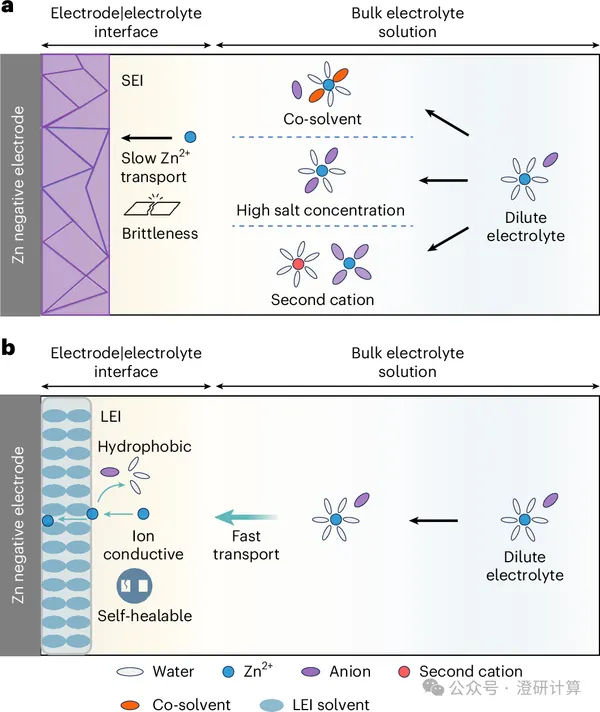
Battery
Nature Nanotechnology: Guo Zaiping & Wang Chunsheng propose hydrophobic liquid LEI for stable and efficient aqueous zinc batteries
Read OriginalIn aqueous zinc-based electrolytes, the Zn anode is prone to hydrogen evolution, corrosion, and dendrite growth. Traditional approaches typically rely on high-concentration salts or co-solvents to regulate the electrolyte bulk, but this reduces ionic conductivity and may introduce cost and safety issues. This Nature Nanotechnology paper proposes a liquid electrolyte interfacial layer (LEI) strategy: adding a small amount of hydrophobic ether additive DEE to a 3 m Zn(OTf)₂ aqueous electrolyte allows it to spontaneously adsorb and aggregate on the Zn surface, forming a hydrophobic liquid interfacial layer. This LEI repels water, allows ion transport, inhibits hydrogen evolution and corrosion, and improves the Zn deposition morphology, while maintaining the high conductivity and non-flammability of the aqueous electrolyte. Theoretical calculations, primarily using molecular geometry (MD), demonstrate that DEE forms micelle-like aggregates in the electrolyte and accumulates on the Zn surface to form the LEI; adsorption energy and coordination analysis further illustrate that DEE exhibits strong interfacial adsorption and weak Zn²⁺ solvation characteristics.
Read Original