
Battery
Nature Energy: A New Architecture for Aqueous Batteries! Flowing Zinc Slurry Overcomes Dendrite and Particle Aggregation
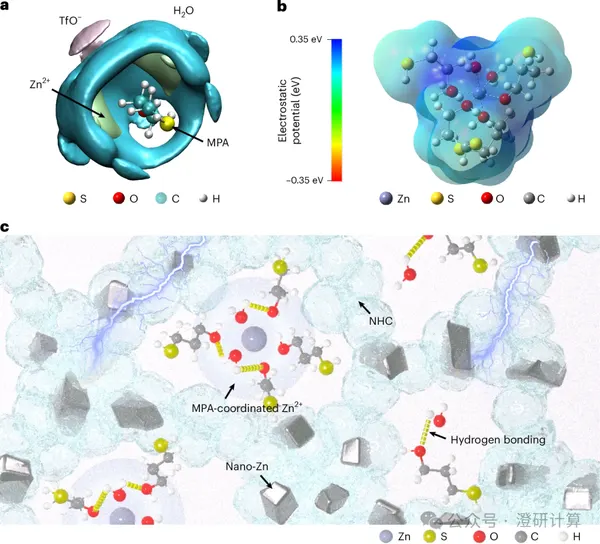
Read OriginalWhile the energy storage capacity of flowing zinc slurry can be adjusted using external storage tanks, zinc particles are prone to aggregation, sedimentation, and overgrowth during circulation, ultimately causing the slurry to lose its fluidity. This paper proposes a flowing zinc slurry composed of nano-zinc, a nano-hollow carbon conductive network, PVP dispersant, and 3-mercapto-1-propanol (MPA) ligand. The ligand confines and stabilizes zinc nanocrystals, achieving uniform and reversible Zn/Zn²⁺ conversion. The optimized zinc slurry achieved a coulombic efficiency of 99.94% and operated continuously for 5128 hours. Matching it with MnO₂ and O₂ cathodes further validated its application potential in long-cycle and continuous discharge energy storage. Theoretical calculations, using molecular dynamics, DFT binding energy and adsorption energy calculations, electrostatic potential analysis, and finite element simulations, explain how MPA regulates the Zn²⁺ solvation and zinc deposition processes.
Read Original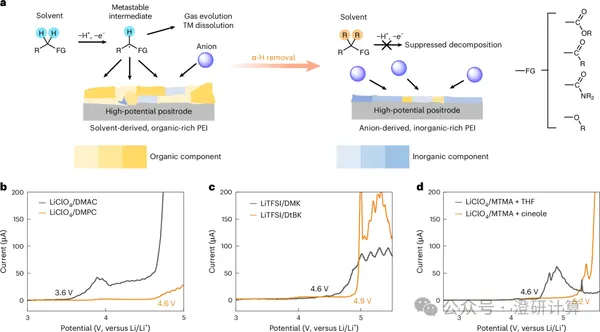
Battery
Nat. Chem.: Removing α-H allows for stable operation at 5.6 V without fluorine! A new design for high-voltage lithium battery solvents
Read OriginalHigh-voltage lithium metal batteries require electrolytes to remain stable above 4.6 V, but conventional non-fluorinated solvents are prone to oxidation, while high-concentration salts and fluorinated solvents face issues related to cost, environmental impact, and decomposition byproducts. This paper discovers that the main failure pathway of carboxylic acid ester solvents is α-oxidation triggered by carbonyl α-H. The authors designed a non-fluorinated solvent, trimethylmethyl acetate (MTMA), by replacing all α-H atoms in methyl acetate (MA) with methyl groups, blocking solvent oxidation, and applied it to high-voltage Li/LRMO batteries and ampere-hour-level pouch cells. Theoretical calculations show that MA radical cations most readily form stable radicals through α-C–H cleavage; removing α-H shuts down this low-energy decomposition pathway. Even with higher HOMO values for MTMA and other α-H-free molecules, their actual oxidation stability is still significantly improved.
Read Original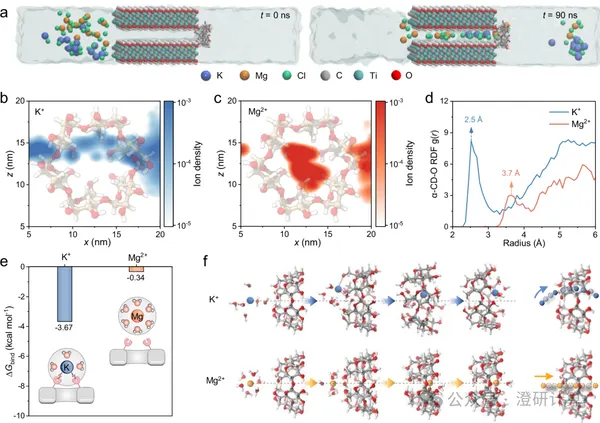
Porous materials and separation transport
Interpretation of Nat. Commun. Reviewer Responses: Supplement and Explanation of DFT and MD Models in MXene Ion Separation Membranes
Read OriginalIn peer review responses, theoretical calculations are not only used to explain experimental results, but also often require further explanation of the model configuration, the objects of calculation, and the physical meaning of the results. This Nature Communications work immobilized α-cyclodextrin at the entrance of the MXene interlayer channel and used DFT and MD to explain K+/Mg2+ separation. Reviewers raised several comments regarding hydrated ion binding, α-CD adsorption configuration, the rationality of the MD model, and the selection of calculated ions. The authors responded to each point by supplementing the adsorption configuration, concentration experiments, and model comparisons.
Read Original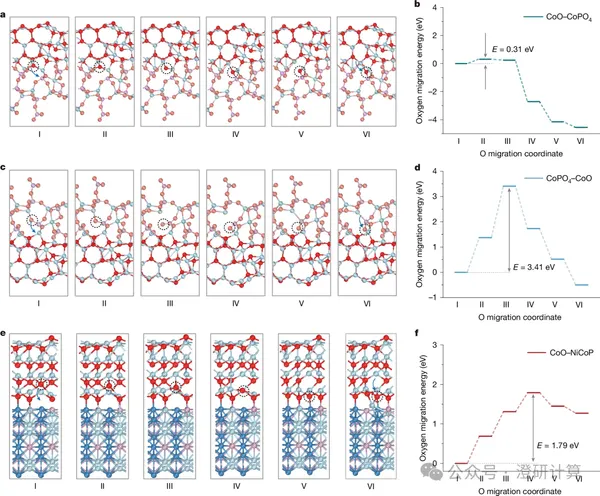
Catalysis
Nature's main journal calculations (CI-NEB) reveal the dynamic passivation mechanism of a 10,000-hour intermittent seawater electrolysis cathode
Read OriginalRenewable energy power supply is intermittent, and frequent start-ups and shutdowns cause the cathode of seawater electrolysis to rapidly rise from the reduction potential to a high potential, leading to catalyst oxidation and exacerbating the adsorption and corrosion of halide ions such as Cl−. Based on this, Sun Xiaoming and Zhou Daojin from Beijing University of Chemical Technology, along with Liu Bin from City University of Hong Kong, designed a NiCoP–Cr2O3 cathode. This cathode forms a multi-layered passivation structure in situ during shutdown and restores hydrogen evolution activity upon restarting, achieving 10,000 hours of intermittent alkaline seawater electrolysis. Theoretical calculations further analyzed the oxidation sequence of Co, P, and Ni, oxygen migration within the passivation layer, the inhibition of Cl− adsorption by phosphate, and the promoting effect of Cr2O3 on alkaline hydrogen evolution kinetics.
Read Original